|
Getting your Trinity Audio player ready...
|
In June 2026, Burkina Faso’s Transitional Legislative Assembly passed a law giving the state new powers to license and monitor religious worship. Weeks later, Captain Ibrahim Traore told Burkinabe students studying Sharia in Saudi Arabia that they need not come home, framing the choice of what to study abroad as a question of national loyalty. A government that can suspend preaching and threatens someone’s citizenship over a course of study has decided that religious authority is, at bottom, a security problem, something to be licensed, monitored and disciplined from above.
Kenya is fighting a version of the same battle from the opposite direction, and from below rather than above. During the 2024 Finance Bill protests, young Kenyans accused churches of accepting political donations while remaining silent as the state used force against demonstrators, and told clergy to return the money before expecting to regain anyone’s trust. Where Traore reached for a decree, Gen Z reached for a demand addressed straight at the pulpit. That is the more interesting fight, because it is being waged through persuasion and public shame rather than law, which makes it slower and messier, but also more honest about what accountability from a religious institution should actually look like. Burkina Faso is useful here only as the outer edge of what state control of religion can become. From here, this piece stays in Kenya.
My argument is that Kenya’s churches, particularly the Pentecostal and charismatic institutions that dominate the country’s religious economy, have built a financial and political relationship with the state that Gen Z is now the first generation to seriously question from inside the pews rather than from outside them. Paul Gifford’s scholarship explains the theology that made this relationship possible. William Ruto’s conduct since 2024 shows exactly how a sitting president exploits it. A small number of clergy and lay institutions are demonstrating, unevenly, what it would actually take to break the pattern.
The question Gen Z is actually asking is not abstract, and it deserves to stand largely in the protesters’ own words rather than mine. “I’m here because our country’s money is being misused,” one protester told reporters outside Jesus Winner Ministry in June 2025, days after President Ruto donated twenty million shillings to that same congregation. Occupy Church’s own organizer, Mwabili Mwagodi, put the same challenge more bluntly to the churches themselves: “Where is this money coming from? Bring us the receipts.” Even some of the clergy have started to frame the comparison the same way. In his 2025 Ash Wednesday homily, Nakuru’s Catholic Bishop Cleophas Oseso warned that congregations should not be seen accepting political donations while “schools have no books and hospitals have no medicine”. That was the actual framing of the question. Not a general complaint about corruption in the abstract, but a direct comparison between what a single Sunday donation cost and what an unfunded clinic or classroom costs the same week.
The economics of miracle and tithe
Harambee itself is not the problem. It began as a genuine communal practice, neighbours pooling money for school fees or a hospital bill, and much of it still works that way at the level of a village or a church congregation raising funds for a borehole. What changed is scale and direction. Once national politicians discovered that a harambee podium could double as a campaign stage, the same word came to describe a president handing over millions of shillings in a single televised gesture, and the distance between those two things is most of what this argument is trying to name.
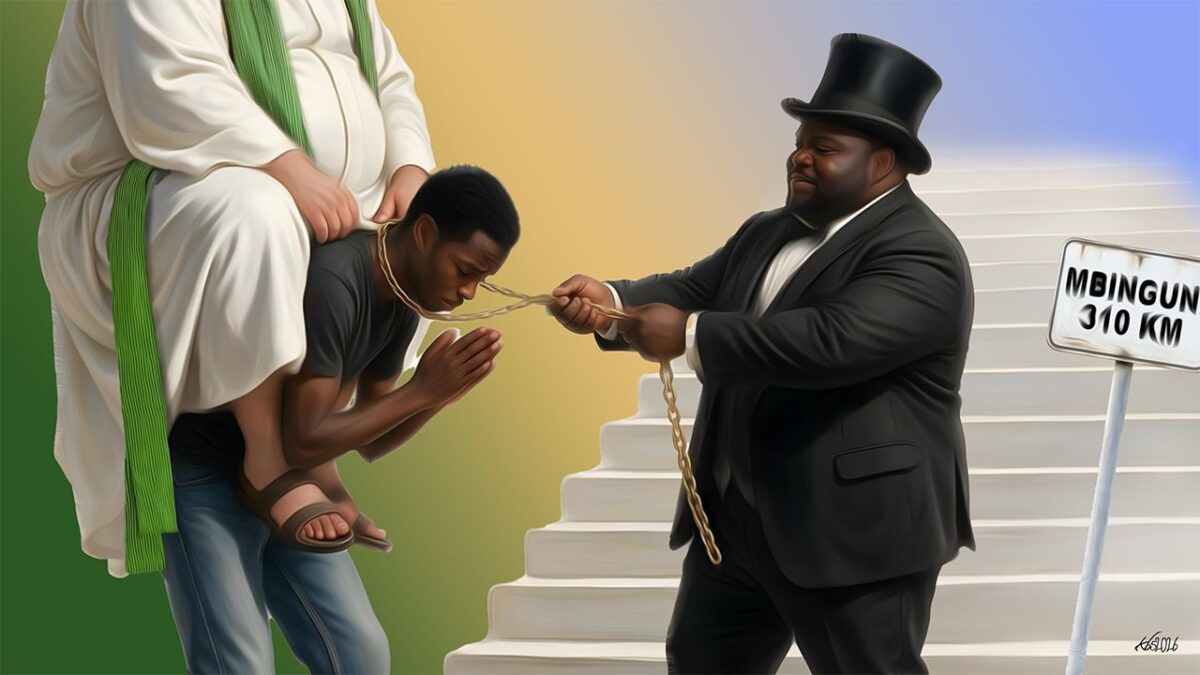
Paul Gifford’s decades of research on Kenyan Christianity describe how the prosperity gospel replaced older forms of church accountability with a direct transaction between believer and preacher. A pastor promises breakthrough, healing, or business success. The believer gives, often well beyond what they can afford, because the sermon has recast giving itself as the mechanism of the miracle. The old model, where a congregation could hold a church leader to account because it funded him collectively, gets replaced by something closer to a bet. Gifford’s sharper point, the one that matters for this piece, is what that bet does to politics rather than to individual believers. Once poverty is read as a spiritual test rather than a policy failure, a government that cannot deliver jobs or functioning hospitals gets a pass it has not earned. The theology absorbs the anger that should be landing on the state.
Ruto’s church donations are not, on close reading, generosity at all. They are a laundering operation for political risk. Money that his own administration had just ruled off-limits for harambees, on the stated ground that harambees were a breeding ground for corruption, becomes acceptable the moment it is reclassified as personal giving inside a church building. In March 2025, four months after that ban, Ruto stood in a Nairobi church and handed over twenty million shillings, describing himself, in his own words, as a product of giving to God. No one at the altar asks where the twenty million shillings came from. The pastor needs the building finished. The president needs a cheering congregation on a Sunday morning. What looks like piety is really just money changing labels, government cash going in one door and coming out the other looking like personal faith.
The clearest evidence that these events function as theatre rather than charity came, unexpectedly, from inside Ruto’s own coalition. In December 2025, his estranged former deputy Rigathi Gachagua alleged that congregations at Ruto’s church visits were partly manufactured, supplied with matching attire and headgear and instructed to cheer on cue, with cooperating bishops accused of campaigning rather than preaching. Gachagua has his own reasons to make Ruto look bad, and the claim should be read with that in mind. But it describes, in more detail than anyone outside government had previously offered, exactly the mechanism this piece is arguing for, a congregation as an assembled audience rather than a community freely blessing a benefactor. Ruto’s own conduct has done little to contradict it. In October 2025, he publicly complained that a Pentecostal denomination he had given ten million shillings to had failed to properly credit him, and warned that his willingness to keep funding it depended on better recognition. A gift that comes with an invoice for gratitude was never really a gift.
Both the Catholic Church and the Anglican Church of Kenya have since sent some of Ruto’s donations back. That refusal matters more than it might look. It is a rare instance of a Kenyan religious institution declining money it was structurally free to keep, and it shows that the prosperity economy Gifford describes is not the only model operating in the country, even if it is the dominant one. The gap between a church that returns state money and a church that builds a new wing with it is, in practice, the gap this whole argument is about.
The politics of pulpit and ballot
Ebenezer Obadare’s study of Nigeria offers a useful frame for reading Kenya, even though the country is different. He describes Pentecostal pastors becoming brokers of state power in their own right, courted by politicians who need the congregation’s votes and the pastor’s moral cover, until the church itself starts to look less like a check on the state and more like an extension of it. Kenya’s version of that broker relationship runs through elections rather than any formal alliance. Politicians attend church because congregations vote, and because a pastor’s endorsement, or even a pastor’s neutral silence during a scandal, is worth more to a campaign than most newspaper coverage. I think this is the actual mechanism the Gen Z’s demand is aimed at, not the money on its own. A politician who cannot buy a pastor’s silence loses a cheaper and more effective form of campaigning than any newspaper advert, which is why the demand to return donations provoked so much more resistance from the political class than its shilling value alone would explain.
Kenyan clergy have started to say the quiet part out loud. CITAM’s Bishop Calisto Odede has admitted that church leaders let politicians borrow the pulpit to build influence they never earned through service, and the National Council of Churches of Kenya has told political leaders bluntly that the culture of lies has to end. What strikes me about that admission is that it came from inside the institution, not from a critic outside the faith. Bishops do not usually describe their own profession as a favour bank for politicians unless the pressure to say so has become too public to avoid. That the admission happened at all is itself evidence of how far Gen Z’s pressure travelled in a single protest cycle.
Retired Presbyterian cleric Timothy Njoya, whose pressure helped force the harambee ban in the first place, has argued for years that a church willing to bless whoever is in power stops being a check on that power and becomes one of its instruments. Njoya’s critique predates the Gen Z protests by decades, which is worth sitting with. The protesters did not invent this argument. They inherited it from clergy who had been making it since well before finance bills and hashtags, and then did something earlier generations could not; they attached it to a mass movement with enough numbers and enough media attention that a president’s own government had to legislate against harambee giving in response.
There is also a plain asymmetry in how this accountability actually works. A Kenyan bishop who keeps accepting Ruto’s money can be named, quoted, and shamed in a newspaper the next morning, which is exactly what happened to Bishop Odede. That is accountability through embarrassment rather than through law; it cannot fine, suspend, or prosecute anyone the way a regulator or a court could. But it does not require the state to first claim any power over conscience, and it moves at the speed of public attention rather than the speed of legislation.
Kenya did try the legislative route too, briefly, and the result complicates any easy claim that the ballot is simply cleaner than a decree. The Public Fundraising Appeals Bill, 2024, would have required state officers to obtain permits for harambees and forced every contributor to declare the source of their money, giving Ruto’s own ban actual legal teeth. The Senate killed it in November 2024, with senators defending Harambees as the cornerstone of national cohesion and warning the law would hurt poor Kenyans who rely on fundraisers for school fees and hospital bills. That defence is not obviously wrong on its own terms. But it was delivered by the same political class that benefits most from a system where a well-timed donation buys goodwill no audit can touch, and it is worth noticing that the chamber which killed the bill is largely staffed by the sort of politician Gen Z accuses churches of laundering money for in the first place. Kenya’s elite did not need Burkina Faso’s junta to show them how to protect this arrangement. They protected it themselves, through an entirely ordinary legislative process.
The possibility of reform
No part of this argument holds if it ends up saying Kenyan religious institutions are only ever extractive, because that is not true and the country’s own record proves it. The Catholic Justice and Peace Commission has run voter education, election observation, and conflict resolution work since 1988, training parishioners on their constitutional rights rather than simply preaching to them. Around past elections, it has worked alongside the National Council of Churches of Kenya, the Supreme Council of Kenya Muslims, the Kenya National Commission on Human Rights, and independent observer groups, an interfaith and secular coalition built for one job: holding the state to account rather than for growing any single institution’s congregation. What that coalition gets right, and what Ruto’s giving and most Pentecostal fundraising get wrong, is the direction in which the money and effort flow. CJPC’s work moves resources and expertise toward citizens so they can check the state themselves. The prosperity model moves resources toward the preacher and the politician, and asks the congregation to trust rather than check. The same faith produces both models. The difference is entirely about who ends up holding the power to verify a claim.
A second, less institutional answer has emerged alongside CJPC’s work. The Occupy Church movement, organized by Mwagodi, staged protests inside and outside services specifically to force pastors who remained silent during the 2024 crackdown to address the source of their donations, with the explicit goal of separating church from politics. Where CJPC works through trained coalition partners and formal observation, Occupy Church works through disruption and public pressure inside the sanctuary itself. Both are betting that Kenyan religious institutions respond faster to public pressure than to any regulator. On the evidence of the last two years, that bet has forced more admissions out of the clergy than the Senate’s own attempt at legislation ever did.
That coalition model is, I think, the most useful thing Kenya’s own religious institutions could scale up rather than import from anywhere else. It keeps religious authority in public life, which is realistic given how central faith remains to how most Kenyans understand justice and community, but it ties that authority to one specific, checkable task instead of an open account of loyalty a politician can draw down whenever he needs a stage. The obvious next step is widening who gets a seat at that table, past the mainline churches and Catholic institutions that already sit there, to the Pentecostal megachurches whose pastors have the deepest financial relationship with State House and therefore the most to explain.
It is worth asking directly why those megachurches are the ones missing from coalitions like CJPC’s, rather than assuming the gap is an accident of scheduling. A church that depends on tithing and prophetic promises for its operating budget has a business reason to avoid the kind of scrutiny that voter education and election observation invite, because the same congregation being taught to question where a government’s money comes from will eventually ask the same question about the offering basket. Mainline and Catholic institutions, with more diversified funding and older institutional structures, have less to lose by joining a coalition built around accountability. The megachurches most entangled with State House have the most to lose, which is exactly why their absence from that table is not incidental.
Gen Z’s demand, Njoya’s decades-old critique, the Senate’s failed bill and Occupy Church’s disruptions are, in the end, four attempts at the same wager, that Kenyan religious institutions can be pulled back toward accountability without anyone having to legislate faith itself. I do not think that wager has paid off yet. Ruto kept giving after the ban, and kept demanding recognition for it. Most Pentecostal pastors have said nothing like what Odede said. The Senate protected the very arrangement Gen Z was protesting. But the pressure is not going away, and unlike a decree, it does not require trusting any single office holder to apply it fairly.
I write this having watched both the 2024 protests unfold on Nairobi’s streets, and harambee arguments play out in the churches since. I do not want this piece to resolve neatly, because I have not found a clean answer to the question underneath Gen Z’s demand – whether Kenya’s religious institutions can be trusted with the power and money they have accumulated, or whether that trust always ends up being paid for by someone who never agreed to the terms.